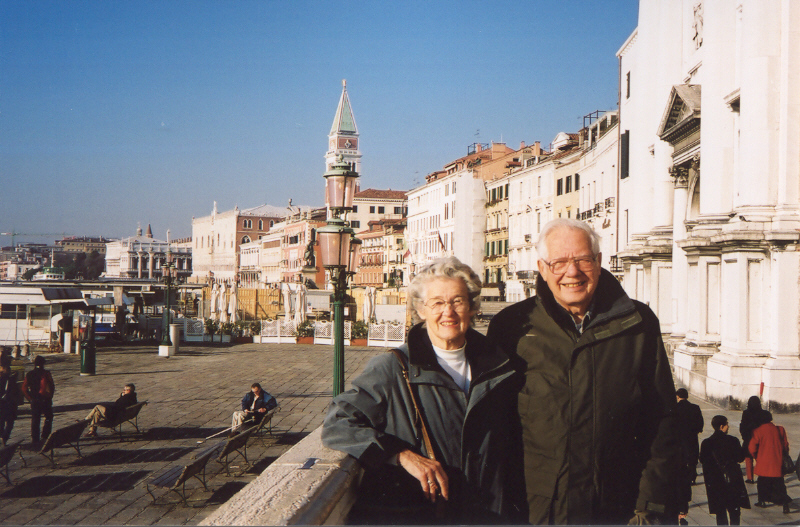
Jack's Saga of Venice
November 2001
|
|
Jack's Saga of Venice November 2001 |
Sunday Monday Tuesday Wednesday Katherine & Scott arrive Thursday Friday Saturday Sunday
|
VENICE NOVEMBER 2001 Saturday, November 17th Off by car for the Rochester airport at 1:00 and at Sky Blue ticket counter by 3:15 for the 5:25 plane to JFK. At JFK we took the bus from Terminal Six to Terminal One for our overseas flight. There on the second floor of the terminal, a line snaked from the security area back along the hallway. Our tickets were obtained at Lufthansa, and then on to the long line and into the maze which led to the X-ray units – surprisingly it was only a 30 minute wait on line to clear security. Phyl, however, was the cause of a slight delay when her knee set off the alarm! No sign of Todd. To the waiting area. Todd appeared just as the plane begins to load. Lufthansa Economy Class does not have too much to say for itself. The space between rows of seats is at a minimum, and if the person in the row before one reclines the seat, you have that individual in your lap. There was one consolation on this trip – no crying babies, albeit we did not get much sleep en route. Into the Frankfurt Airport in the wee hours of the morning (NY time). The airport is huge – and, naturally, our plane was at the far end of a string of terminals. At our Venice gate we had only a brief wait until the plane for Venice took off. Over the Alps, the spectacular peaks stretched out below us as we headed over southern Germany and Austria above snow-capped peaks and rugged terrain. Soon we were flying over the plain between the Dolomite Alps and the Venetian lagoon. The plane gracefully soared over all of Venice below us, and so down into Marco Polo Airport. A walk through the customs area (passports had been cleared in Frankfurt for the EU countries) and to money exchange for enough cash to pay for the motoscafe to Venice. Across the lagoon to Murano, to the Lido, and so to the Vallaressso dock from which we pulled our wheeled luggage behind along the Molo to the Savoia e Jolanda Hotel – the one hotel we wanted to stay in. A nice room in the re-done hotel, and we stretched-out since the night and day en route had been long. A late dinner in the hotel that evening with a wonderful zuppa verdura and a cotelleta Milanese! (Happily, the hotel offers 25% off the bill for residents.) A brief walk thereafter before tucking in for the night. Bed linens were turned down by the maid each night before we reached our room. Breakfast was interesting – not the
usual Continental breakfast, but a full panoply
For an extra fee, we entered the former choir area which, aside from its altar, has a set of huge, gilded arm chairs in which the Doge and entourage could be received in the annual pilgrimage to the convent of San Zaccaria to thank the nuns for giving up their orchard land in what was to become St. Mark's Piazza. It was the nuns of this convent who originally gave the corno, the Ducal hat, to the Doge.* A side chapel in what had been the original church (to which Codussi and his predecessors' addition now makes up the main church) adjoins the choir area and here one can view the crypt below it in which earlier Doges were buried. Entry into the crypt is not possible since it is filled with water, as is always the case in this low lying area of the city . Todd wanted us to see the Bellini painting of the Virgin and child, the most noted painting in the church, and so he put the requisite 500 lira into the light box so we could enjoy the lovely painting by Bellini. Then out into the campo in front of the church, the necessary pictures were taken of Codussi's Renaissance facade of the building – and of an altana with its greenery atop one of the buildings right behind our hotel and across from San Zaccaria. Altana such as this one provided a place in which Venetian ladies in the past could bleach their hair in the fashion of the day. Today Altana provides a small private park in a densely populated city. Along the narrow, commercial Salizzada San Provolo to the canal which runs between the Doges' Palace and the Prison to stop to watch a piling being driven into the canal as a nesting place for boats on the waterway. Alongside the canal was a small shop of the Bevilaqua looms, and here Phyl obtained some rich woven tassels as gifts. Into the Piazzatta Leoncini, with a stop beforehand to look into the courtyard of the Basilica's office buildings, We were en route to the American Express office on the Salizzada San Moise so as to cash Travel Cheques for sufficient funds for the week's visit. Then down the Calle Vallaresso, exclusive shops on one side and on the other side of this narrow way the former palazzo which held the Ridotto gambling rooms in the 1700s where masked revelers could lose a fortune until the Signoria put a stop to this private enterprise by starting its own State lottery. At the end of the calle is Harry's over-rated bar on the left and the de luxe Monaco and Grand Canal Hotel on the right – our home last time due to Scott's kindness. We were headed for the new tourist office/book shop in the former classical "Coffee House" at the Lagoon behind Harry's Bar in order to obtain week-long passes on the vaporetto and three day passes for Scott and Katherine for their arrival in two days. Back to the Salizzsado San Moise to stop to take a picture of the over-decorated front of the San Moise Church. It was the facade of this church which caused John Ruskin to break out into hives every time he had to pass it since it did not reflect his beloved Gothic architecture and had nothing Christian about it. The old Venetian saying, when they were in opposition to the Pope and the Curia, which was often the case, that they were Venetians first and Christians after, applies here as well as at San Zaccaria since once more one finds another variation in Venetian faith. Not only was Zacharia, the Jewish father of the Jewish John the Baptist, not a Christian, but neither was Moses – who is here viewed as yet another Christian saint (S. Moise) in the Venetian holy pantheon. But, then, to Ruskin' s sclerotic disposition and disapproval, high above the portal of the church is the bust of the wealthy Venetian, Signor Fini, who paid to have the church re-done, and who is here remembered for his generosity and his need for recognition into eternity . The church is named for Moses in part because an earlier benefactor was of that name (Moise). Within the church, the main altar is a huge sculpture of "Mt. Sinai and Moses Receiving the Ten Commandments." Perhaps a more Christian note can be found in the side sculpture of "Finding the True Cross" depicting the legend of the discovery of the cross in the 300s A.D. by the gullible Empress Helen, the wife of Emperor Constantine, on her journey to Palestine in the 300s. Most churches have interred residents of note. Here the two most noted individuals are rather notorious. One is John Law, the Englishman behind the Great South Seas Bubble which ruined untold numbers of speculators in financial investments in the 1700s. Here, in exile, he was to die. Also entombed here is the famed courtesan Veronica Franco who left money to reform other courtesans or for the money to go to penniless young women so as to keep them from her profession. We followed the Calle Largo XXII Marzo (named for the date on which the rebellion broke out against the Austrians in 1848), with its banking establishments, exquisite shops, and restaurants, to the Campo Santa Maria del Giglio with the statues on its facade commemorating the four Barbaro brothers and their military successes against the Turks – the bases of the columns of the facade depicting the fortresses of their victories. This was another of the "barbarous" churches which sent Ruskin into a continuing tizzy since there was nothing Christian about the façade – and not a Gothic note in sight, as well as commemorating a secular family who had paid for the facade. It was getting to be lunch time, despite that full breakfast at the hotel, and Todd found a little bar/cafe where we had sandwiches and beverages - these tiny establishments throughout the city provide not only good places for light meals but, best of all, they also have a gabinetto which is needed after walking about in cool weather.
Through the Campo del Traghetto to
the temporary bridge thrown up across the Grand The Church of the Salute was still being decorated for the festive pilgrimage on Wednesday, 21 November. Rich hangings were being placed over the main portals, and, within the church, the walls of the altar area and the columns supporting the dome over the altar were clothed with sumptuous damask. The altar depicts not only the Virgin, but it also shows an angel driving away the plague. Leaving the Salute and proceeding down the Calle Abbazzia, under the sotto portego of the former monastery , and on to the rear of the Palazzo Dario and to the entry to the Palazzo Venier dei Leone, the home of Peggy Guggenheim' s Collection. We did not go in since Scott and Katherine had indicated that they wished to visit the museum.. We did, however, stop in the Guggenheim book shop on the Fondamenta Venier. We were en route to the Accademia, which to our disappointment is closed on Mondays.
Thus we took the vaporetto down
the Grand Canal to the Stazione S. Lucia of
Dinner was in a nearby restaurant on the Calle Largo San Marco – crowded and rather noisy and with only fair cuisine. A stroll through the Piazza, along the Molo and into the Danielli Hotel to see its splendor. We decided that it was not only overwhelming with its marble and its three story tall lobby, but it was too ostentatious for our taste – or pocketbook. The Savoia e Jolanda looked better by comparison.
Then we took the vaporetto down the Giudecca Canal to the San Basilio landing and to the church of San Sebastiano. The church is noted for its frescoes and paintings by Veronese who is buried just below the organ whose doors he richly decorated. A bust of the artist stands next to the organ doors. The richness of Veronese's paintings has made the church famous. The convent connected to the church is now a part of the University of Venice whose architectural school is partly located in this area. The doorway to the former convent, now a portion of the university, is of a modem design by Carlo Scarpi, simple but striking. One can easily know that this is a university area by the graffiti everywhere against multi-national corporations, against the bombing of Afghanistan, etc. On to the church of the Angelo San Raffaele, which is under restoration. One can enter the church, but almost all of the interior is currently under wraps. A verger very kindly tried explaining the story of the church, but since the elderly gentleman only conversed in Italian, we did not get anywhere. Next we walked to the San Nicolo dei Mendicoli, one of the few early churches, which still has its covered porch at the end of the nave as protection for communicants in poor weather - and where the "mendicants," the poor, could beg for alms from church goers. The basilica form is richly decorated with statues of the apostles on the side walls. There is a fine iconastasis with statues, and then at the altar there is a very large wooden image of St. Nicholas with three golden balls in his lap, such as he threw to the poor virgins in the traditional legend. This was one of the poorer districts of Venice, its fishermen and working men were individuals of little means. They were, in one sense, almost self- governing, and they had their own gastaldo, the "Doge" of this poorer district. It was the area of the "Nicoletti," the fishermen of the area, who fought battles with the men of the Arsenal, the "Arsenalotti," over certain parapet-less bridges in Venice in the past. These brawls at times were so bitter and murderous that the government finally had to put a stop to them. Opposite the San Nicolo church is the huge complex of the former Venetian Cotton Mills - now the home of the Architecture Department of the University of Venice, an institution which pours out thousands of young Italian architects who will never find work in their desired field... We continued along the Fondamenta of the Rio dei Carmine with the Fondameta Briati on the other side of the canal - the site of the famed Briati factory, the first one to be permitted back on the main islands since the middle ages. Among the noted palaces here are the Palazzo Ariana across the canal and then the Armenian College in the Palazzo Zenobio - whose splendid halls and putti in stucco on elaborate ceilings are seldom open to public viewing. We were headed. to the Carmine church, pausing but briefly there to look at its interior with its magenta colored columns - it was nearing noon and we could not linger since we wanted to see the adjacent Scuola del Carmine before it closed for the lunch hours. The Scuola has a facade by Longhena in the classical mode. Its interior is furnished with handsome, paneled, wooden walls, and it is noted for a number of paintings by Tiepolo done for the confraternity .A marble staircase leads to the upper floor where the Madonna del Carmelo is the center piece in the main hall which served as a chapel. The two adjacent rooms on this floor are enriched with excellent wood paneling and frescoed ceilings. It was now noon, and we walked on to the Campo S. Margherita where Phyl wanted to photograph the little Scuola of the Furriers at one end of the campo. Todd disappeared into a book store or two (we had to remind him how when he was five, he did his best to deter Jack from disappearing into such shops) while we surveyed the fish stalls which were set up in the market place. Interestingly, the printing on the boxes of fish indicated that they were the product of Norway. We were just a stone's throw (so to speak) from the Frari and naturally we had to wend our way in that direction, past the Scuola Grande di San Rocco, and so into the Frari itself. We had a chance to view the 124 wonderful wooden choir stalls which still stand in front of the altar as did other such choirs in times past. The famous Assumption of Mary by Titian marks the center of the apse, and the right side of the apse holds the mortuary monument to Doge Foscari while the left side has the funerary urn of Doge Nicolo Tron. Three chapels are on either side of the main altar area, the furthest on the left being the Chapel of St. Ambrose, and here is buried the composer Claudio Monteverdi in front of the altar. The chapel to the right of the main altar area is the Florentine chapel enriched by the long-ago Florentine residents of Venice who donated the statue of St. John the Baptist, the only work by Donatello in Venice. Among the noted funerary units at the side door of the left aisle is the massive sculpted tomb of Doge Giovanni Pesaro, and just before it, toward the main entrance way of the church, is the very large, stone pyramid which holds the heart of the sculptor Canova. Canova designed the tomb for Titian, but his students saw to it that it served as a memorial to their master. Titian is buried across the way from the Canova tomb with a massive sculptured edifice as a memorial to the artist. Adjacent to the Frari is its one-time huge convent, now the repository for the archives of the Venetian Republic - 15 million documents from the 9th century to 1797 and the fall of the Republic. We walked into its first cloister but did not enter the building itself since one obviously must have a purpose and a reservation to view the archives. From here we walked along the Calle Larga Prima to the Campo San Toma with the San Toma church, an impressive structure with its classical facade, albeit it is now abandoned as a church. Facing it across the campo is the former Scuola of the Calegheri, the Cobblers, now a branch of the public library, which Phyl had wanted to (and did) photograph. Just around the comer Todd found a delightful small, modem restaurant whose walls are decorated with photos of Hollywood stars of the past - a place to which we shall have to bring Scott and Katherine! Toasted anchovy sandwiches sent Todd and Jack into ecstasy, although Phyl ordered something milder. Here Jack discovered Beck beer from Bremen, a new delight. After lunch Todd took off to explore part of his old neighborhood from his summer's stay in Venice as a student years ago. We took the vaporetto - getting on at the wrong platform and thus headed down toward the Rialto where we changed for a boat in the right direction. We had to be back at the San Zaccaria dock by 2:55pm for the small craft which would take us to the San Lazzaro degli Anneni monastery on an island close to the Lido. At the Lazzaro, one lands at a small, narrow dock, which was hard to navigate what with those on it who wanted to board our boat for a return to San Marco. The forecourt of the monastery has a lovely garden with a memorial statue to the founder of the monastery as well as plaque of remembrance of Byron's having studied the Annenian language here. A rotund, middle-aged monk appeared to lead the small group of some ten people into the monastery, where at a desk one's entry fee is paid. He began his lecture, in English, in the lovely cloister with its many plantings, and then he led the group into the chapel in which he continued to lecture. Alas, given the acoustics and Jack's hearing deficiency, he got little of what was said, albeit it must have been humorous at times since the group laughed heartily at some of his comments. Next he took us into the monastic museum, a small room with a most heterogeneous collection of artifacts, ranging from an Egyptian mummy to items of a religious nature. On the wall is a portrait of Lord Byron, since it was in this room that he studied Annenian. Legend has it that Byron swam from the palazzo in which he was living on the Grand Canal to this island far out in the lagoon. We were taken into the refectory, its table set up for the next meal for the Monastery's eight monks, a table which seems dwarfed in this long room. Meals are taken in silence while the youngest monk reads devotional materials to the group. The final room visited was the new Library, a round room under a large rotunda ceiling, and here on display are some of the treasures of the monastery, illustrated manuscripts and other documents dating back to the early middle ages. The tour, ended, we had to await the 5:15 motorboat back to San Zaccaria. Todd spent the time taking many pictures of the sunset over the lagoon and the main islands and Mestre across the waters. Back at the hotel we rested while Todd went out for another walk before dinner in a small rather noisy and crowded restaurant. We started out this morning along the Riva degli Schiavoni, noting the building in which Petrarch lived, a gift from the Signoria for his donation of his library to the Republic (which lay dormant in a room in the Doge's Palace for some 100 years before the Marciana Libreria was created). Our goal was the Scuola degli Schiavoni, and en route we stopped at the church of San Giovanni Bragora in the Campo Bandiera e Moro. The Baroque building adjacent to the church was the former Scuola di San Giovanni Batista. The church is noted as the one in which Vivaldi was baptized as a child. Across the square is the huge Palazzo Gritti from the 1300s, a palazzo whose exterior walls were once covered with frescoes.
On to the Scuola of the Schiavoni,
only to discover that it was closed since this was
Walking along the canal past the exceedingly long Tana building where the ropes for ships were once created (the building gets its name from the town in the Black Sea area where the hemp was obtained), we reached the Lagoon and approached the Naval Museum – closed for the holiday! While Phyl waited on the bridge over the Arsenal canal, Jack went down to the Fondamenta to take pictures of the 1473 Forni Militari where the bread and biscuits were once baked for the Venetian fleets. Adjacent to the Forni on the Lagoon is the Ca' di Dio, a huge hostel of the 1200s for pilgrims en route to the Holy Land (and the Crusades) and later for destitute women. Today it still serves as a home for the elderly. Then we returned to the Tana, walking along its huge extended length (a bit of graffiti on one wall "Bill Clinton # 1") and down the Via Garibaldi where, since this was a holiday, all the locals were out in force doing their shopping. Here were boats at the end of the canal which were serving as vegetable markets. We cut across the canal part way down its length and into the area which had once provided the housing for the Arsenalotti, the coddled workers of the Arsenal, stopping in the Campo di Ruga to survey the old residences and the two palazzi on the square. At the end of the Salizzada Stretta (Arsenalotti housing duly photographed) we turned into the short alley which leads to the bridge to the Isola San Pietro – and the church of San Pietro in Castello. Cadussi's Istrian stone campanile stands out in the green sward before the church - one of the few green plots in front of a Venetian church. This was the first campanile to be clad in stone instead of having a plain brick exterior. The Istrian stone facade of the church is Palladian in nature, completed by one of his followers, perhaps to his plan. The original church went back to the early years of Venetian settlement when a castle once stood on this isle (thus San Pietro in Castello). The church was the seat of the Bishop and later of the Patriarch of Venice from 775 until 1807 when the Patriarch's seat was moved to the Basilica of San Marco. The Signoria always kept the authority of Rome at a full arm's length distance by keeping the seat of the Vatican representative on this isle. Of course, the bishop, and later the Patriarch, were always chosen by the Signoria - just as local parish priests were chosen by the parishioners. Venice never wished to be under the thumb of the Pope or the Curia. The most noted item in the church is the supposed throne of St. Peter which he is claimed to have used in his peregrinations in the Holy Land. The fact that it is made up in part of an Islamic tomb stone with quotations from the Koran makes the traditional claim of its authenticity a rather dubious one. Back through the Camp di Ruga to the canal and the Via Garibaldi. We cut through the Public Gardens past the massive memorial to Garibaldi, and so to the vaporetto dock at the Biennale Garden. We sailed past the Marinaressa, the building built as residences free of charge for sailors who had performed services to the Republic. Its large vaulted openings lead to streets beyond the lagoon. We met Todd at the Correr Museum in the Piazza for tickets to visit the Libreria Marciana. One has to walk through the main floor of the museum, and at its end one is in the main hall of the Marciana. Here once were held the many volumes of classical literature bequeathed to the Republic by the humanist Cardinal Bessarion and by Petrarch from his library. The hall is magnificently decorated with paintings of the philosophers by Veronese, Tintoretto and Andrea Schiavone. Framed paintings adorn the ceiling by seven artists who were chosen by Veronese and by Sansovino, the architect of this palatial library building. Veronese's painting on the ceiling was considered so fine that he was awarded a gold medal by the Republic. We were actually approaching the library from the rear, for the next small hall is an entry hall or vestibule whose ceiling has Tiatian's "Wisdom" painting. Beyond it is the stairway which is similar to the Scala d'Oro of the Doge's palace. Below, at the Piazzetta entryway, two gigantic caryatids grace the doorway leading to the monumental stairway. On leaving the Libreria to return through the Correr Museum, one can go through the Archeological Museum of Greek and Roman statuary .This magnificent collection of the classical past was donated to the Republic by Cardinal Grimani in 1523 from finds from excavations in Rome. It was enhanced by another donation by another Grimani, both important humanist scholars of the Venetian Renaissance.
We
After lunch we walked through the Piazza, where Scott decided that we had to have another picture to add to the family portraits of Venice - one of Katherine seated on one of the lions in the Piazzetta Lioncini. That was duly taken, then another one with both Katherine and Scott astride one of the Piazzetta' s two famed lions. We also went to the rear of the Piazzetta to pay our respects to the tomb of Daniele Manin, the 1848 patriot who led the rebellion against the Austrians and who eventually died in exile. He was honored with this special burial place in a niche outside the Basilica -since he was Jewish and thus could not be buried within the Basilica or Zanipolo. From the Piazza we went on to the Campo di Traghetto and the temporary bridge over the Grand Canal to the Salute. The bridge was packed - as was the narrow calle at its far end. A policeman at its end was guiding traffic, permitting the flow from the east, the north and the south to make its way to the church. The Calle Abbazia leading to the Salute is a narrow street, and now it was packed people to people, wall to wall Crowds were also arriving by vaporetto, and thus one moved slowly through the masses into the packed church. Katherine had obtained a candle, and so she and Scott made their way slowly forward to where an altar boy took the candle and placed it in a holder in honor of the Virgin (displacing other candles offered by earlier visitors – to the ire of some "pilgrims"). Meantime Todd and we remained outside admiring the procession of fur coats parading past us, obviously not the product of the local equivalent of Wal-Mart.
Pedestrian traffic was one way
coming into the Salute area along the Calle Abbazi, and therefor one had to
follow the crowd over the wooden bridge onto the
The street turned into another and wider branch of this Rio Terra, again lined with stalls and crowds of people. Thus we made our way to Fondamenta Zattera and the Saloni ex Magazzini dei Sale, the one-time salt warehouses which first brought prosperity to Venice from the evaporation of sea water for salt to sell to the mainland. One of the cavernous units was open for a photographic exhibit (of which one could purchase duplicate photos), but it was not one to linger over. We continued along the Fondamenta, still jammed with people from the water's edge to the facades of the buildings lining the Fondamenta. At the Fondamenta Bragadin we turned to the right to follow the Rio di San Vio canal toward the Grand Canal. Lights were coming on in apartments across the canal, and thus one could see the interior of some of the units. The Fondamenta ended at the Campo San Vio with its Anllican Church which had been a center of Anglo-American social life in the 19 century, and thus we continued along the Nuova Piscina Forner to the Accademia landing. We were wearing down, but indefatigable Todd insisted that the Accademia could not be by-passed, and thus we "did" the Accademia. I am afraid that the pictures of the medieval and later periods of Christian myths hardly cut an ice with me, but those of the later Renaissance were more to my taste. We particularly enjoyed seeing Giorgione's "The Tempest," Tintoretto's famed mythical "Saving the Body of St. Mark," and Veronese's "Supper in the House of Levi" - originally a "Last Supper" but whose title he had to change when the Inquisition made too many pointed inquiries as to why there were drunks, hunchbacks, German troopers, and other less than "holy" individuals in the picture.
Exhaustion setting in, we took the
vaporetto back to the hotel for a rest before dinner. Todd had previously
scouted around and had found a very nice restaurant in the Rialto area. Thus in
time we took the vaporetto to
Passing under the archway of the Procuratie Vecchie, we came out into a fog shrouded Piazza San Marco, the windows of the two Procuratie lined with candles which truly enhance the scene of an evening.
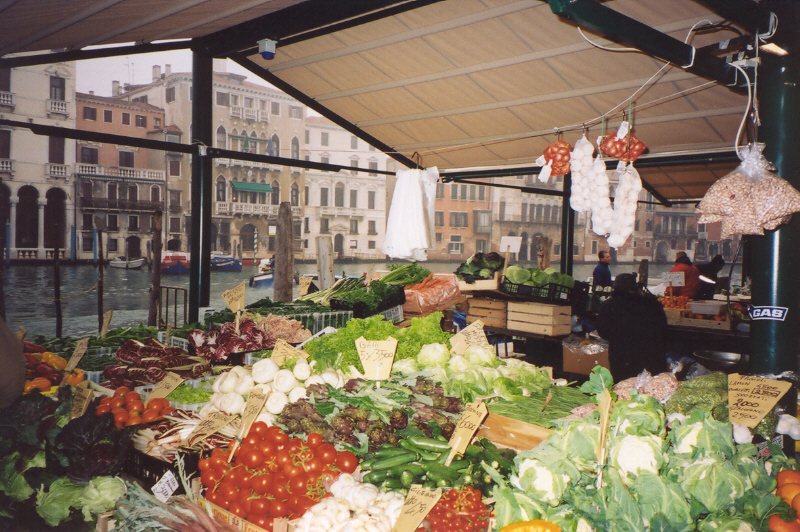
Early this morning Scott, Katherine, and Todd set off by foot to explore the open-air produce and fish markets at the Rialto. Todd wanted Katherine and Scott to see the Bellini in San Zaccaria, and thus we started the day's walk to that church behind our hotel with an opportunity to see the Bellini painting of the Virgin. Then from the Campo San Provolo we walked the Fondamenta Osmarin to the San Giorgio dei Greci Church. This was an area given to the Greeks in Venice by the Signoria, much as the Ghetto had been given to Jewish residents, albeit there were no guards or curfew for the Greek settlement. Here the Greeks could practice their Orthodox rites, have a school, and at one time a burial ground. (Church burial grounds were eventually closed since they could pollute the wells upon which each campo was originally dependent.) We went into the church with its icons in the Greek and Byzantine style, its iconastasis separating the altar from the congregation, and then, outside, we viewed its leaning campanile and the Collegio Greco Flangini with its museum of icons. Continuing along narrow streets and over bridges to the Fondamenta Furlani, we reached the Scuola degli Schiavoni, the one time confraternity of the Slavs from Dalmatia who were the low paid laborers and the sailors who manned the trading ships with the far side of the Aegean Sea. The walls of the ground floor of the scuola have the famous paintings of Carpaccio, including "The Triumph of St.. George," three paintings recounting the tale of the handsome, blond St. George killing the dragon which besieged a Libyan town - and thus his rescue of the king's daughter from the dragon. Naturally, as a Christian saint, he baptized everyone in the town (with the exception of the dragon who was apparently too far gone for such beneficence). Noted too is his painting of "St. Augustine in His Study". Here is Augustine in a late medieval study with books on the shelf and small art objects, and even his little dog sitting obediently to one side. The upper hall, up a narrow staircase, was the chapel for the confraternity, and it too is lined with paintings of the life of Jesus. Todd went on
his way at this point since he wanted to return to the neighborhood in which he
once lived,
Back at the hotel we now met Todd and went by vaporetto to Dorsuduro for the Peggy Guggenheim Collection. Whereas yesterday one could cross the Grand Canal on the temporary bridge to the Salute as late as the hours before midnight, the bridge was now gone in its entirety. At the Guggenheim Museum we began by having lunch in its small café. Then we spent time seeing her modern collection of pictures. Now Todd took off for the Redentore on the Giudecca which he wanted to visit once more while Catherine, Scott, and we took the vaporetto to the San Marcuola stop and walked the Strada Nuova to the entrance to the Ghetto Vecchio through a passageway in one of the tall ghetto apartment buildings and so into the Ghetto Nuovo. At the bookshop, we arrived just in time for a tour of the synagogues. The woman who was the guide took us up the flights of stairs to the Scuola Tedesco, one of the older synagogues, on the upper floor of a building so that it would attract no undue notice, due to restrictions on the Jews of the Ghetto in the past. It had its five exterior windows (the Five Books) on the third floor overlooking the Ghetto Nuovo campo. It has its women' s balcony where the women could hear the services but neither partake in them nor be seen by the men on the floor below them. The guide pointed out the anomaly that above the upper interior walls were representations of Biblical places, an unusual depiction in a synagogue since such representations were contrary to Biblical teachings. She next led us to the Scuola Spagnola in the Ghetto Vecchio (which is the newer or extension of the original Ghetto Nuovo). Here the ground floor was for a religious school for children. Mounting the steps to the second floor, one comes into a much larger main hall which shows the influence of Longhena who worked in this and on the adjacent Scuola Levantina. Here again the women' s gallery is high above the main floor of worship. Today the women are seated behind the men, a screen maintaining their traditional distance from the male worshippers. (As the remaining Jews in the Ghetto and in Venice in general have aged, an additional set of stairs to the women's gallery proved to be just too much.) The Ark has a balustrade with a gateway before it (Longhena obviously was influenced by Christian uses where the altar had to be separated from the worshippers), and classical columns adorn the setting for the Ark. There is a richness to this synagogue (as well as with the Levantina) which is lacking in the earlier ones – but then the Spanish and Levantine Jews were a wealthier group than were those from Germany and the north. It was
beginning to grow dark, and we returned to the Strada Nuova and walked toward
the Rialto. Along the way we stopped at a food store to purchase some
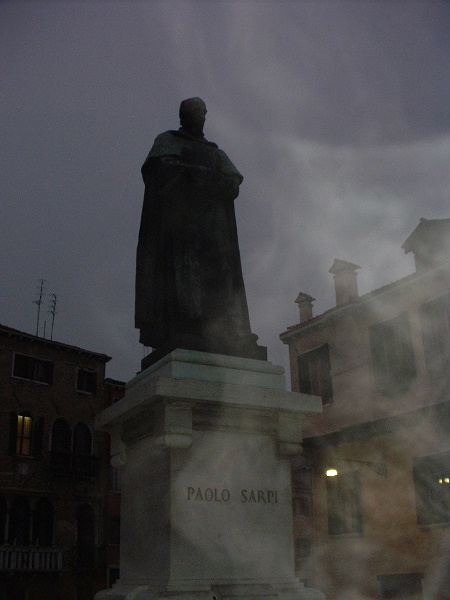
Sarpi was the priest who defied the Vatican and the Pope in advising the Signoria to ignore the Pope's interdict against Venice - thereby defeating the Papal ability to interfere with secular states. Sarpi' s monastery once stood here, and here one night he was knifed by minions of the Pope, surviving what he recognized as the Style (stilleto) of the Curia." It was not until the 1890s that a statue could be raised to Sarpi because of Vatican objections, but under the new Italian Republic, the statue was created. Meantime, when the monastery was dissolved in the early 1800s, Sarpi's bones were disinterred and are now buried within the entrance to the San Michele Church on the cemetery island of San Michele. As we walked along, Scott fortunately noted the directional
sign to the vaporetto at the
At 8:24 we took the vaporetto
which stopped first at the San Michele
Within the grounds there is a lovely forecourt with flowers and evergreens planted in a patterned format. We went into the church where a funeral service was going on. Thus we stayed at the back, noting the marker just inside the main door of the honorary spot where Paolo Sarpi's bones were laid to rest in 1828 when his monastery was dissolved and its cemetery removed.
We then walked through the island
with its many mausoleum, each with flowers on the multi-tiered units and a
picture of the person interred. Then into the
Back to the dock and the brief ride to the Faro stop at Murano where boats had to be changed. We walked down the Via Garibaldi to the Fondamenta dei Vetrai, passing by a furnace with the name of Tagliapietro on it. Up the Fondamenta to the sotto portego building, looking into all the glass shops en route - and then back to the dock for the boat to Burano/Torcello. It is a longish ride to Burano, where the boat first stopped at Mazzorbo. We expected the vaporetto to go on to the Burano dock and then to have lunch there before heading to Torcello. To our great surprise, the boat went on directly to Torcello and here we disembarked. A new walkway is obviously under construction to the cathedral area, but the old walkway along the canal leading into the center of the former town offers a pleasant walk. Two restaurants along the way were tempting, but we were not certain whether the cathedral would close at noon, so on we went, passing the Devil's Bridge without parapets. Paying for our tickets, we did explore the cathedral, using the head sets which offer a guided tour in English. The huge fresco on the rear wall is as fascinating as ever with the religious accounts of Jesus, the saved in Heaven, the damned in Hell. The Byzantine Madonna hovering over the apse is most impressive as are the apostles lined up below her. Under the altar, in a glass topped sarcophagus, is the body of Saint Heliodorus, the first bishop of Altina, whose body was brought here when the Altinese fled the mainland and the Lombard invaders. His face is covered with a golden mask, and he is clothed in his vestments. We explored the small crypt under the apse above which is the bishop's throne raised high up a series of steps with tiers of seating on either side of the stairs to the throne. Of interest also was a small section of the present floor which has been excavated to show the original mosaic floor of the 600s before the church was re-done after 1100.
Phyl was particularly interested
in the small martyrdom church of Santa Fosca since she wanted to see the diaper
and other brick work at its external rear apse. We explored this, and then the
remains of the one-time baptismal unit attached to the rear of the church, and
then viewed the cathedral
Back
When the boat arrived,
it did not go to the Burano dock but to the Mazzorbo dock. We diverged
inland, exploring a path to the Burano bridge, passing some
Across the bridge and down to the main street, the Fondamenta di Mauro, along the central canal to the Via Baldassare Galuppi (a native son and composer noted for his music) with its many tourist shops and restaurants. We came upon a group of Japanese tourists whose local guide was lecturing to them in English. They had just stopped outside the headquarters of the Democratic Socialist party (ex-Communist Party). The guide explained to them that she belongs to the Communist party since they had the best red wine on the island...
We headed for the restaurant in
which we dined the last time on the island, Todd in the distance waving
After our late noon-time meal (3:00 p.m.) we walked down to the Piazza Galuppi and the San Martino Church and the Merletti School, the lace making school. Every shop in town was offering lace work for sale, the native craft - many of the selections which no doubt now have their origins today in Taiwan and China. Back through small lanes along canals, with the little houses in reds, greens, yellows, blue, a most picturesque village, and so to the dock for a return to Murano. There we disembarked and made our way along the Fondamenta dei Vetrai, over the bridge across its canal, and past the church which, unfortunately was closed at this hour - it is worth seeing with its lovely Muranese glass chandeliers. Over the bridge which crosses the main canal at the Palazzo da Mula, one of the former "summer retreats" of the well-to-do in late medieval and Renaissance Venice, along the Fondamenta Cavour, around the corner, and along the canal of San Donato, and past the Glass Museum in the former Bishop's Palace of 1680, closed at this hour. In 1291 the Signoria decreed that all glasshouses had to be moved to Murano from the main Venetian islands - so as to eliminate the danger of fires from the glass furnaces as well as to protect the secrets of Venetian glassmaking from the rulers of northern Europe who lusted after the exquisite glass of Venice. Although glassmaking can be dated to the 900s in old documents, the museum only retains glass from the 1400s on - including the famed Barovier wedding bowl and other masterpieces of Muranese masters in glass. We ended our walk at the Santa Maria e Donato church with its external apse with its many columns. The church was still open, and we went in to view its magnificent mosaic floor from 1140, restored by the Save Venice Fund. Against a golden background in the apse is the Byzantine image of the Virgin, gently lit in the evening dusk, very similar to the Byzantine Virgin in the apse of the cathedral at Torcello. Todd and Phyl had lagged behind in order to obtain something in the local Co-op food store, and thus, as they explored the church, Katherine and Scott and Jack walked back to the Fondamenta Cavour and down an alley way which led into a campo, in one building of which, from the glow of light from within, a worker was creating lampworked glass. Dusk was settling in, with a spectacular display of color against the clouds in the sky .-which had to be duly photographed. Onto the vaporetto and off at the Fondamenta Nuova to walk down the narrow calle and eventually to Zanipolo which was open -and interesting to see in the early evening light. Afterwards, a ciocolatta was essential in a little cafe just alongside the great Colleoni statue. Then on by various side ways, led by Todd who knows all the crooked calli of this area, to the Santa Maria Formosa. En route, Katherine and Scott decided on a short cut back to the hotel while we three explored the Formosa church - and its mask at the foot of its tower which Ruskin said was "too horrible even to describe." Such easily wounded sensibilities! So to the hotel and afterwards to dinner again at the Restaurant San Stefano next to the Rio San Provolo between San Zaaccaria and the Basilica - without the American table across the way in which the husband had carried on a vigorous and opinionated conversation the evening before.
Later that evening Katherine and
Scott realized that we had never been to the Cafe A lovely, clear and sunny day. At 9:30 we were off by vaporetto to San Giorgio. We arrived before the church opened at 10:00 a.m., and thus we walked along the waterfront alongside the church and then back in time to enter the now opened church. This is no doubt Palladio's most impressive church in Venice, and it reflects his great interest in classical Roman architecture. Its choir is behind the altar, and above the choir are statues of major apostles. We took the little elevator up to the top of the campanile, and the view in all directions was magnificent. Behind Venice the peaks of the Alps loomed in the far distance, snow capping some of their tops. One could see all of Venice - from Mestre on the mainland with its oil cracking plants to the left and Murano and the Marco Polo Airport far to the right. It was a photographer's paradise - in fact, we thought that Todd would never descend since he was so busy taking pictures. The vaporetto down the Giudecca Canal to San Basilio once more, and then down narrow ways and along the Calle Lunga di San Barnaba. This was an area in which those patricians who were down-and-out came to live in cheap dwellings in Venice's heyday, supported in part by the charity of the Signoria. It was also noted for its Ponte di Pugni, its Bridge of Fists, where the Nicoletti and the Arsenalotti had their vicious brawls. It was noted too for its prostitutes who, by order of the Signoria, had to leave their breasts bare. The Signoria had a horror of homosexuality, and this order was to let patrons know who were true prostitutes and the real thing - and who were transvestites seeking partners. Any convicted homosexual was burned at the stake in the Piazzetta outside the Ducal Palace. Given the amount of homosexuality recorded in the past, it is doubted that few patricians ever suffered this fate. We arrived at the Ca' Rezzonico, much changed since our last visit. Here Pen Browning had lived after he married a rich American, and here his father, Robert Browning, died. The grand staircase leads up from the main portego, no longer a warehouse and loading dock area but a palatial entry to the palazzo. The ballroom on the floor above is one of the largest of Venetian palaces, and the many rooms today are enriched with furniture of the Settecento since it is the Museum of Venice in the 1700s. The frescoes of Giambattista Tiepolo enrich the piano nobile. Portraits by Rosalba Carriera enhance the walls of one salon while another salon is graced with the pictures by Pietro Longhi reflecting life of an age gone by. The top floor has now become an extensive picture gallery, although it still retains a room set up as an apothecary shop of the past. Afterwards we walked along back calle past the double Giustinian Palazzo and the Palazzo Foscari, both now main buildings and a library of the University of Venice. Over one bridge, we could look down upon a "barge" filled with the belongings of a family who were moving into one of the buildings alongside the canal. Our goal was that pleasant little restaurant of the San Toma
Campo with all the
After a brief rest at the hotel, we and Todd took off for the Rialto, going down the Mercerie and stopping to visit the San Zulian and then the San Salvatore churches which we had not visited previously. Over the Rialto Bridge to take a picture of the former Fondaco dei Tedeschi, now the Central Post Office, and then to the little square in front of San Giacometto. Here a picture had to be taken of the Gobo and Bando from which laws of the Signoria were once promulgated. Then a walk among the stalls on the Ruga di Orefici, to the Riva del Vin, and then back across the Rialto Bridge. From here we walked back among shopping streets to the hotel, at one shop in which Todd stopped to look at pens as possible office Christmas gifts he must give. A restorative cappuccino was taken en route. Earlier, Todd had found an interesting restaurant near the Accademia, and there we went later that evening, only to discover a line in the street waiting for a free table - it obviously was a good choice, but not one which was readily available. Thus we crossed the Accademica Bridge and to the San Stefano Campo where a likely place was only serving those with reservations. Instead we found a lovely restaurant on the Campo San Stefano -after which we retired to the Cafe Quadri on the Piazza. In the time of the Austrian occupation of Venice, for almost two-thirds of the 1800s, Venetian patriots would enjoy the Florian - but never the Quadri where Austrian officers and Venetian supporters of the Hapsburg enjoyed their coffee. That is all past history now, and thus one is free to enjoy these two lovely cafes - which we did with a hot chocolate with a rich whipped cream topping before eventually returning to the hotel for the last night there. The walk across the Piazza was a delight, for every window in the two Procuratie and the Ala Napoleonica had electric candles in their windows, making the Piazza more of a fairyland then ever. Our departure day from Venice. We still
had not visited all the museums which our over-all Once more over the Alps to Frankfurt where security control backed up masses of people, making for a late departure for our plane for New York. Into the far-too-narrow Lufthansa seats, we arrived at JFK on time. There Todd hailed a cab which took us to the Ramada Hotel at the edge of the airport, and he then went on to his apartment. The hotel was not up to the standards of the Savoia e Jolanda – in fact, we could not use the tub since the water handle was frozen solid Out at 7:30 by van to Terminal Six, we arrived to find, to our dismay, that a line stretched more than a block long for entry into the terminal. Inside, it continued its "mile long" line within the building and then evolved into mazes -which might, within a day or two, lead to the ticket counters. Two hours on line as our departure time became more imminent. Finally a Jet Blue attendant called for all those going to Rochester to leave the line and to follow him. This we did, got our seat passes, and then had to endure another long, double line headed for the security devices. The plane took off 30 minutes late -but made it to Rochester on time nonetheless. Off the plane, luggage obtained, the car re-possessed by us, we stopped for breakfast (at noon) in a diner across from the airport. Then the 1½ drive home to Corning. Venice was now but a lovely memory! When do we return to the Serenissima once more??
|
|
updated 08/05/07 |